

How Maternity, Paternity & Parental Leave Work in Quebec: What Parents need to Know
A practical breakdown of QPIP so you can plan your maternity, paternity & parental leave, protect your income and avoid costly mistakes
In this guide, we cover:
Who qualifies for QPIP benefits - including if you are self-employed
How the Basic Plan and Special Plan work
How maternity, paternity and parental benefits are calculated
When you should apply for QPIP
How benefits are taxed
Whether you can earn income while receiving benefits
Important timing rules that can cause parents to lose benefit weeks

If you are pregnant in Québec or planning a baby, congratulations ! Now, take a deep breath...here comes good news: you live in one of the few places in North America where parental leave is actually generous (side eye to our neighbours down south where, in some cases, dogs are legally required to spend more time with their puppies than women are with their newborns).
That said, the QPIP website feels like it hasn’t been updated since 2007, and is packed with information that isn’t exactly easy to navigate. It is full of rules, exceptions, and traps that can cost you money if you do not plan ahead.
So let’s break it down in a way that makes sense.
What QPIP actually is
QPIP stands for the Québec Parental Insurance Plan. It replaces federal EI for maternity and parental leave in Québec and it is generally more flexible.
There is no minimum number of hours worked: what matters is income. This is a huge win for moms who are self employed, contract workers, or juggling multiple income streams.
Are you eligible ?
Most parents are, even if they are not in a traditional job. Here is the eligibility criteria:
Be a resident of Quebec at the start of the benefit period. If you are self-employed, you must also be a resident of Québec as of December 31st of the previous year
Have paid or owe QPIP premiums (these are usually automatically deducted on your pay)
Have earned at least $2,000 in insurable income during the qualifying period
You must also have stopped working or reduced your work activity by at least 40%. This applies whether you are an employee, self employed, or a family type or intermediate resource. In other words, QPIP is not just for your traditional 9 to 5 workers.
The different types of benefits explained
QPIP is not one single benefit: it is a mix of benefits that work together. Here are the different types:
Maternity benefits are for the person who is pregnant and gives birth, and can start as early as the 16th week before your due date, but must end 20 weeks after the birth of the baby.
Paternity benefits are for the parent who did not give birth. They exist so that parent can actually be present to care for the baby, not just squeeze in time between meetings. These benefits can start the week the baby is born and must generally end no later than 78 weeks (18 months) after birth.
Parental benefits are for both parents. These weeks can be taken at the same time or at different times, depending on what works best for your family. Some parental weeks are shareable between parents, while others are exclusive and cannot be transferred.
Here is the fun part: if both parents take a minimum number of shareable weeks, bonus weeks unlock. Yes, QPIP rewards teamwork (nudge to your partner).
The Basic vs. the Special Plan
You have two plans to choose between, and this is one of the most important decisions you will make. You cannot switch plans once the choice is made.
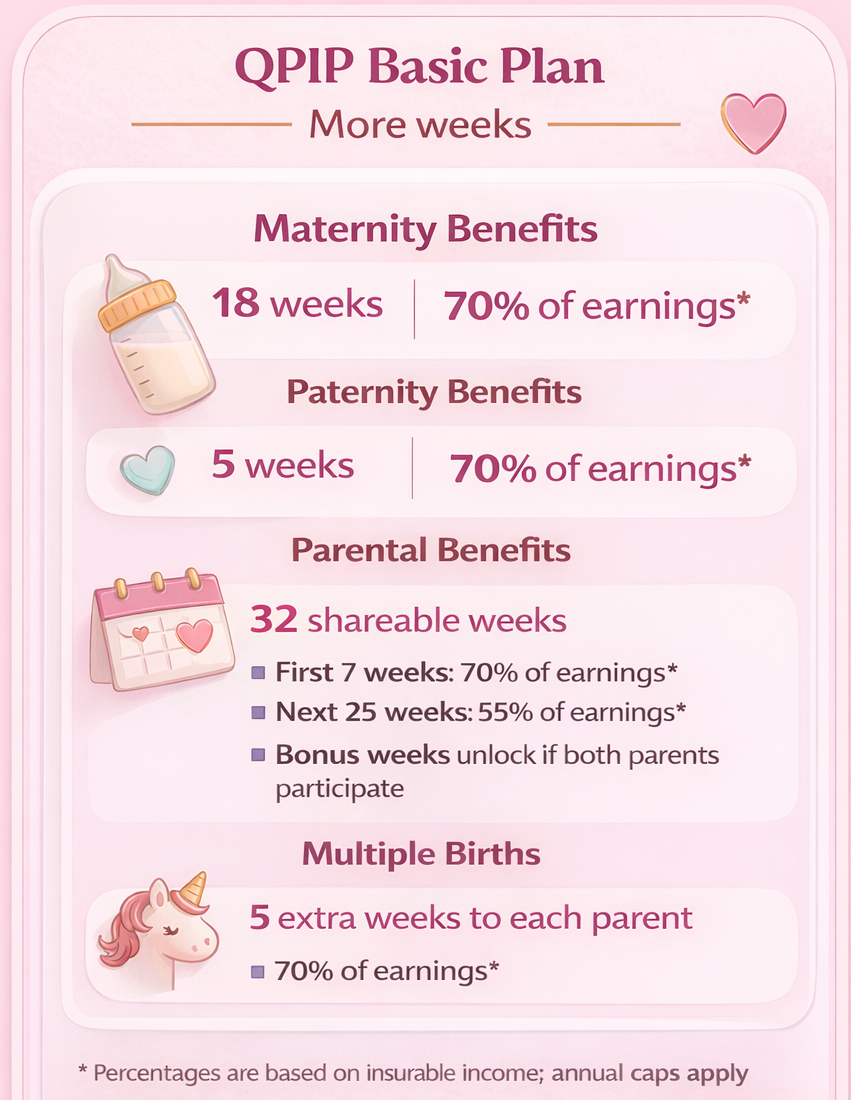
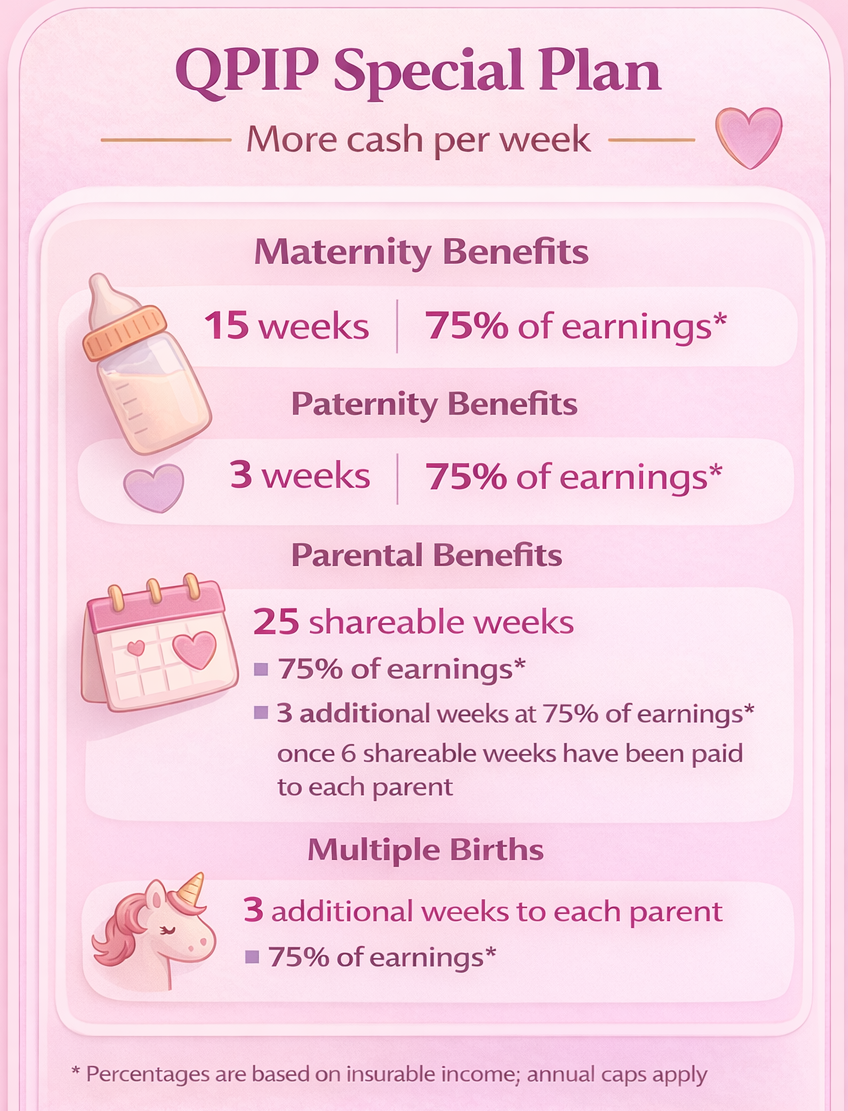
Under the basic plan, you receive a lower weekly amount but for more weeks; under the special plan, you receive a higher weekly amount for fewer weeks as follows (screenshots are welcome):
Hot Money Mom Warning
Under the Basic Plan, maternity benefits last 18 weeks.
However, these benefits normally cannot be paid later than the 20th week following the week your baby is born.
The 20 week clock starts running the week the baby arrives.
Since babies do not always come on schedule, you might want to start maternity benefits when the baby is born if you are opting for the Basic Plan, especially if the baby arrives earlier than expected, so you do not loose weeks.
Keep reading to learn about additional warnings that can affect your maternity benefit weeks.
The basic plan gives you more weeks at a lower rate, while the special plan gives you fewer weeks at a higher rate. Which one is ‘better’ depends on your cash flow and how long you want to stay off.
The best plan is not the longest one: it is the one that fits your actual budget, cash flow and desire to go back to work (you might actually want to... eventually).
Parents who are listed as the only parent on their child’s birth certificate or adoption document are entitled to additional QPIP benefits. Under the basic plan, they can receive 5 additional weeks of parental or adoption benefits at 70% of their income. Under the special plan, they can receive 3 additional weeks of parental or adoption benefits at 75% of their income.
Why do some parents take 18 months of leave in Quebec?
You may hear people say they are taking 18 months of maternity leave, but this does not come from QPIP benefits (meaning a portion of it is unpaid).
Under the QPIP Basic Plan, a family can receive up to:
• 18 weeks of maternity benefits
• 5 weeks of paternity benefits
• 32 weeks of parental benefits that parents can share
This is a total of 55 weeks of benefits.
However, Quebec labour law allows a parent to take up to 78 weeks of job protected parental leave after the birth of a baby. This equals roughly 18 months.
Also, the QPIP paternity & parental benefit weeks must generally be taken within 78 weeks of the birth child, so it is possible to stretch them out by skipping weeks.
Why many Quebec parents do this
Common reasons include:
• waiting for daycare spots
• extending time at home with the baby
• coordinating with a partner's leave
• spreading parental benefits between both parents
The qualifying period
Normally, QPIP looks at the 52 weeks before your benefits begin to calculate your income and is calculated using your average weekly insurable income based only on the weeks you actually worked, not the whole year. In other words, a “gap” does not dilute the calculation.
First QPIP first looks at whether your income was steady or variable before your leave. If you had one employer and your weekly salary was exactly the same for the 26 weeks before you start your benefits, they consider that “steady.” In that case, it’s simple: they just use your normal gross weekly salary to calculate how much you’ll get. No complicated averaging.
But if your pay changed (like varying hours, tips, commissions, multiple employers, or weeks you didn’t work), they consider that “variable.”
For employees, QPIP normally looks at the 52 weeks before your benefits begin, and your benefit amount is generally based on the average of your insurable earnings from the last 26 weeks of that qualifying period.
For self employed workers, the qualifying period is usually the previous calendar year.
So the big difference is:
steady income = they use your regular weekly salary
variable income = they average your best weeks
However, if you could not work during that time because of pregnancy, illness, injury, CNESST benefits, EI, or previous QPIP benefits, the qualifying period can be extended up to 104 weeks.
This can be important for parents who had complicated pregnancies or employment gaps.
There is an official benefit calculator on the QPIP website: use it (it’s also on my Resources page). Guessing your maternity income is not the vibe.
How QPIP calculates how much you get paid
Your benefit amount is based on your insurable income and the plan you choose. It also depends on whether you earn income during your leave and whether you qualify for a low income supplement.
QPIP looks at earnings that were subject to QPIP contributions. This means gross weekly income for employees and net business income for self employed workers.
The maximum insurable income changes each year. It was $98,000 in 2025 and is $103,000 in 2026. Not too shabby.
Minimum benefits for lower incomes
QPIP also includes a minimum weekly benefit. If your income was very low and the normal benefit calculation results in a small payment, QPIP may increase your benefit to a minimum weekly amount set by the program, as long as you meet the eligibility requirements and earned at least $2,000 in insurable income.
This rule helps ensure that parents with lower incomes still receive a basic level of financial support while on maternity or parental leave.

Can you earn money while on maternity leave ?
Great question: yes, you can, and we love that.
Earning income while receiving QPIP benefits is allowed up to a certain amount per week, but it can affect your benefit payments if you exceed the permitted amount.
In general, your work income plus your weekly benefit cannot exceed the average weekly earnings QPIP used to calculate your claim, otherwise your benefits may be reduced.
You need to contact QPIP to figure out the exact amount you are entitled to earn without affecting your benefits. Any amount earned over what is permitted will be deducted from your benefit payment.
Hot Money Mom Tip
You can choose to skip a week of benefits if you know you will earn too much income that could reduce your benefit: just beware of skipping maternity weeks (see warning above) and making sure parental and paternity benefits are used up within the 78 week timeframe.
For side hustle moms, this flexibility is powerful when used carefully.
Common traps that cost parents money
One detail many parents overlook is the timing of paid vacation.
Many parents assume they should use their vacation before maternity leave, but under QPIP this can sometimes cause benefit weeks to be lost - especially since you can not time when baby will come.
If you take paid vacation days within the first 18 weeks after your baby’s birth, you could lose maternity benefit weeks.
Why? Because maternity benefits generally cannot be paid later than the 20th week following the week of the birth. If vacation delays the start of your maternity benefits, those weeks may no longer be payable.
Example timeline
Birth
→ takes 3 weeks of paid vacation
→ then starts maternity benefits
Those 3 weeks of vacation still count inside the 18 week maternity window.
So instead of receiving the full maternity benefit period, the timeline becomes:
Birth
→ 3 weeks vacation
→ 17 weeks maternity benefits: loss of one week
If you have paid vacation available, it is often safer to schedule it after your parental leave period rather than before or during your maternity benefits.
Do not forget about taxes
QPIP benefits are taxable income, and the taxes are deducted right off of your benefit payments. However, this can still result in an overpayment if your overall income for the year remains high, so plan accordingly, and April won’t feel rude.
Unfortunately, it seems that QPIP often does not withhold enough taxes and many moms are left with a big tax bill in April.
You may want to adjust your tax withholdings by calling QPIP or set money aside during your leave.
How and when you get paid

QPIP benefits are paid on Sundays and usually cover 2 calendar weeks at a time.
You can receive payments by direct deposit or by cheque. With direct deposit, funds are usually deposited into your account 3 or 4 days after the payment date. Cheques arrive according to Canada Post delivery timelines.
Direct deposit is, well, faster, safer, and simpler.
A quick word about the Safe Maternity Experience program (CNESST)
If your job poses a risk during pregnancy, the CNESST Safe Maternity Experience program may pay income replacement benefits up to 4 weeks before your due date.
If you receive these benefits, you still need to apply for QPIP to determine eligibility. If you are not eligible for QPIP, CNESST benefits may continue until birth.
This program is incredibly helpful and often overlooked.
Disclaimer: Special family situations
QPIP has specific rules for adoption, surrogacy, same sex couples, loss/pregnancy termination, and multiple births like twins or triplets. These situations can affect how benefits are structured and shared, so it is important to check how your exact scenario is treated if one of those situations applies to you since they are not covered in this article.
Final Hot Money Mom takeaway
Québec has one of the strongest parental leave systems out there, but only if you understand how it works. QPIP rewards planning and punishes assumptions: know your plan, time your income, avoid the traps, and take your leave without financial stress.
Bonding with your baby is a lot easier when your money is handled ahead of time.
Please refer to the QPIP website and my Resources page for more in depth information.
Going on parental leave soon ? Click below to learn how to save $500+ money without changing your lifestyle - free checklist included.
Never want to miss out on a guide like this one ? Subscribe to my newsletter to stay up to date.

13 simple ways to cut your grocery bill without couponing, price matching, or driving to 6 different stores.